

What Is The Purpose Of Drawing A Motion Diagram?
02. Drawing Movement Diagrams in 1D
- Page ID
- 582

- Drawing Motility Diagrams (Qualitative)
- Determining the position from a motion diagram
- Determining the velocity from a move diagram
- Determining the dispatch from a move diagram
Cartoon Motion Diagrams (Qualitative)
The words used past physicists to describe the movement of objects are defined above. Nevertheless, learning to utilize these terms correctly is more than difficult than simply memorizing definitions. An extremely useful tool for bridging the gap betwixt a normal, conversational description of a situation and a physicists' description is the motion diagram. A motion diagram is the showtime footstep in translating a verbal clarification of a phenomenon into a physicists' description.
Start with the following verbal description of a physical situation:
The commuter of an motorcar traveling at xv m/s, noticing a red-calorie-free 30 m alee, applies the brakes of her motorcar until she stops simply short of the intersection.
Determining the position from a motion diagram
A motion diagram can be thought of as a multiple-exposure photograph of the physical state of affairs, with the image of the object exposed onto the film at equal time intervals. (You may have seen photographs of this type taken with a strobe-light.) For case, a multiple-exposure photograph of the situation described above would look something like this:

Notation that the images of the car are getting closer together nigh the end of its motion because the car is traveling a smaller distance between the equally-timed exposures.
In general, in drawing motion diagrams it is better to correspond the object as simply a dot, unless the actual shape of the object conveys some interesting information. Thus, a improve motion diagram would be:

Since the purpose of the motion diagram is to help us describe the car's movement, a coordinate organisation is necessary. Remember, to define a coordinate system you lot must cull a zero, ascertain a positive direction, and select a scale. We will always use meters as our position scale in this course, so you must just select a naught and a positive management. Remember, in that location is no correct reply. Any coordinate system is as correct every bit any other.
The choice below indicates that the initial position of the car is the origin, and positions to the right of that are positive.

Nosotros tin can now describe the position of the car. The car starts at position zero and then has positive, increasing positions throughout the balance of its motion.
Determining the velocity from a motion diagram
Since velocity is the change in position of the car during a corresponding time interval, and we are free to select the time interval as the fourth dimension interval betwixt exposures on our multiple-exposure photograph, the velocity is simply the change in the position of the car "between dots." Thus, the arrows (vectors) on the movement diagram below represent the velocity of the car.

Nosotros can at present describe the velocity of the motorcar. Since the velocity vectors always indicate in the positive direction, the velocity is always positive. The machine starts with a large, positive velocity which gradually declines until the velocity of the car is cipher at the end of its motility.
Determining the acceleration from a motion diagram
Since acceleration is the modify in velocity of the car during a corresponding time interval, and we are costless to select the fourth dimension interval as the time interval between exposures on our multiple-exposure photograph, we tin can determine the acceleration by comparing two successive velocities. The change in these velocity vectors volition represent the acceleration.
To decide the acceleration,
- select two successive velocity vectors,
- describe them starting from the same indicate,
- construct the vector (arrow) that connects the tip of the showtime velocity vector to the tip of the second velocity vector.
- The vector you have constructed represents the dispatch.
Comparing the first and 2nd velocity vectors leads to the dispatch vector shown below:
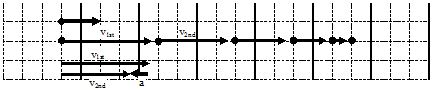
Thus, the acceleration points to the left and is therefore negative. You could construct the acceleration vector at every point in time, merely hopefully you can meet that every bit long every bit the velocity vectors continue to point toward the right and subtract in magnitude, the acceleration will remain negative.
Thus, with the help of a motion diagram, you tin can excerpt lots of information most the position, velocity, and dispatch of an object. You are well on your way to a consummate kinematic description.
Paul D'Alessandris (Monroe Community Higher)

Source: https://phys.libretexts.org/Bookshelves/College_Physics/Book:_Spiral_Physics_-_Algebra_Based_%28DAlessandris%29/Spiral_Mechanics_%28Algebra-Based%29/Model_1:_1D_Constant-Force_Particle_Model/03._Kinematics/02._Drawing_Motion_Diagrams_in_1D
Posted by: woodmanthemarly88.blogspot.com
0 Response to "What Is The Purpose Of Drawing A Motion Diagram?"
Post a Comment